
TL;DR
- A prospect demanding free work is a red flag and a qualification opportunity.
- Pilot conditions: agreed success criteria, short duration, a price, and a commitment to buy on success.
- Confirm their decision process, stakeholders, and timeline before investing your resources.
- Every minute on an unqualified prospect is a minute lost from a good one. Don't give away what you've built.
Free trials that require little to no work from you are fine. Freemium and rep-free web purchase models are common, and that's fine. That's not what this is about.
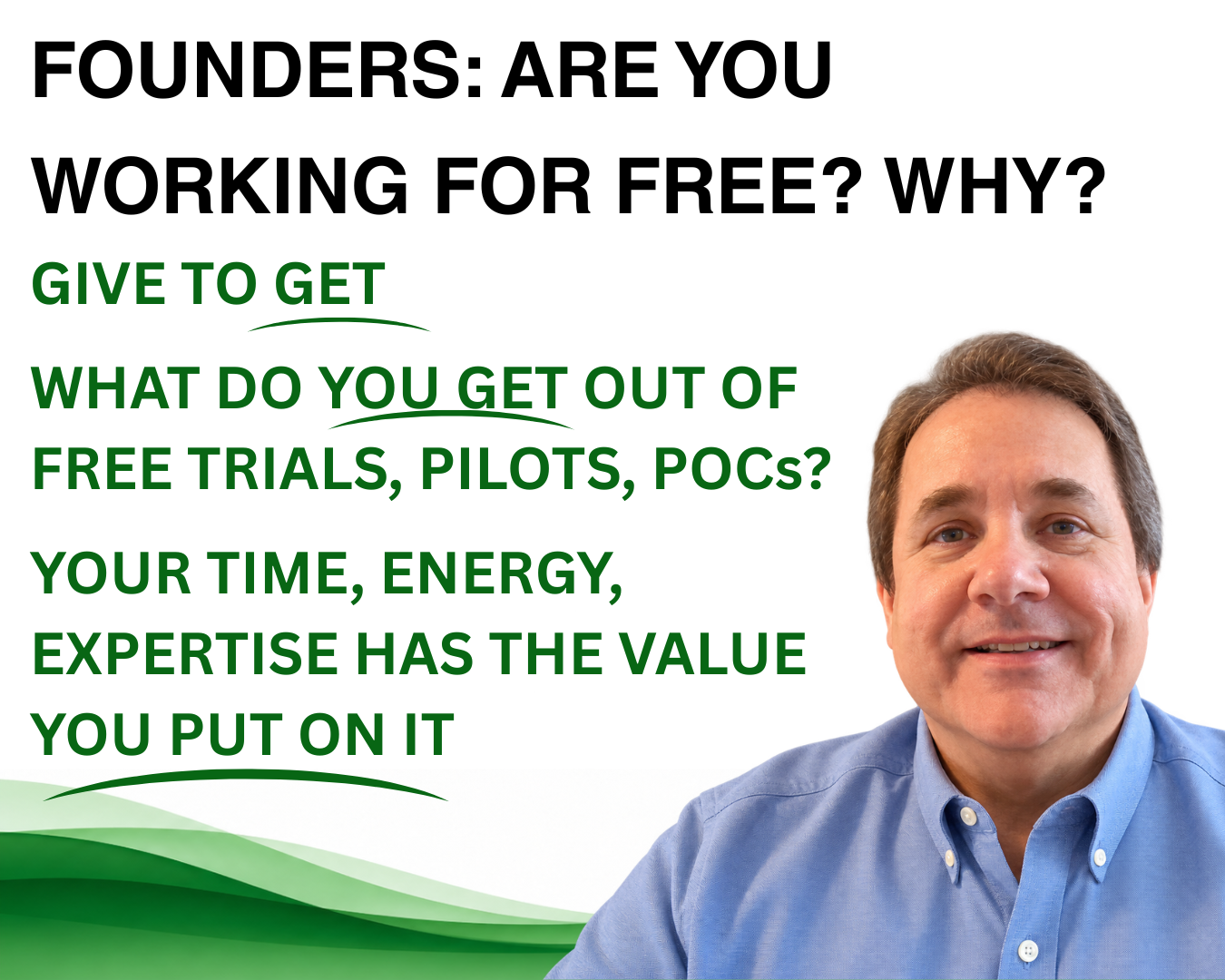
I'm asking you founders of bigger-ticket solutions why you're willing to work for free. When a prospect wants, or demands, a free trial, that's a red flag.
Why would you give away what you've poured your time, energy, and money into building? Ask yourself how reasonable someone who wants you to work for free is. What kind of customer are they likely to be, if ever? What message are you sending about yourself and your company if you agree to work for free?
Don't dismiss it. Discover it.
If free anything comes up, and it should never come from you, you don't have to immediately dismiss it. Look at it as another opportunity for deeper discovery and qualification.
Start by acknowledging what they want, then make your conditions known. You'll soon discover, if you haven't yet, how much real influence and decision-making authority this person has when, instead of agreeing to work for free, you propose a paid pilot under a signed contract with these conditions:
- Measurable success criteria you both agree on
- Duration only as long as you need to demonstrate success
- What you will charge for your work (and whether that gets applied to a future purchase)
- Most importantly, their agreement that upon successful completion of the pilot, they will move forward as a paying customer
Your mindset needs to be that these requirements are reasonable provided your prospect a) fits your ICP, b) has actively partnered with you in good faith on defining a plan for solving the problem, and c) has agreed, at least in principle, with your estimates of the dollar value of your solution, projected ROI, and time to breakeven.
"Greg, can I really expect them to sign when the pilot ends?"
Why wouldn't they? Seriously, what's the point of piloting if not to move into production?
Yes, there's their internal decision-making process for executive buy-in, technical sign-off, legal review, and more. You should have already uncovered, documented, and confirmed what their process is, who is involved, and how long decisions like this typically take BEFORE you agree to invest your time, energy, and money in a paid pilot.
"What do I do if they won't agree?"
They probably won't. Not at first. Be ready for that. What will they accept? What alternatives do they suggest? Is this an account you want badly enough to negotiate alternatives? What would you accept and what won't you accept?
Besides trials and pilots, you'll hear proof of concept. Prospects who say they want you to prove your solution presumably want that proof so they can make a decision. It's therefore completely reasonable for them to at least consider agreeing to become a customer when they get the proof they said they needed.
Expect resistance
They'll tell you your competitors offer free trials, free pilots, and free proofs of concept, and that's just how they do business. It's up to you to decide if you want to, and can afford to, do the same for this account, or if you'll respectfully walk away because your time can be better invested with prospects who fit your ICP better.
Y Combinator Group Partner Tom Blomfield says that, in general, a really long free trial or pilot is counterproductive because the customer hasn't actually bought into using the product. In YC's "How To Price For B2B," he gives founders a better path:
- Keep the pilot short, a couple of weeks or maybe four.
- Set clear success criteria up front, tied to the value the buyer expects to get.
- Ask your champion how much they can approve without the CFO or legal team, and price the pilot under that so it moves quickly.
- If you're confident, skip the pilot. Ask for an annual contract from the start with a 30- or 60-day money-back guarantee.
Can you afford to work for free?
Every minute you spend with less qualified or unreasonable prospects is a minute you can't spend with good prospects.
Your solution has value. Your time, energy, and money are limited.
Don't give it away without getting something of value in return.
Want to discuss this further?
Book a free discovery call and let's talk through what's relevant to your business.
Book a Discovery Call