
Go-to-market: Documenting Prospect Profiles and Buyer Types
Oct 5, 2023
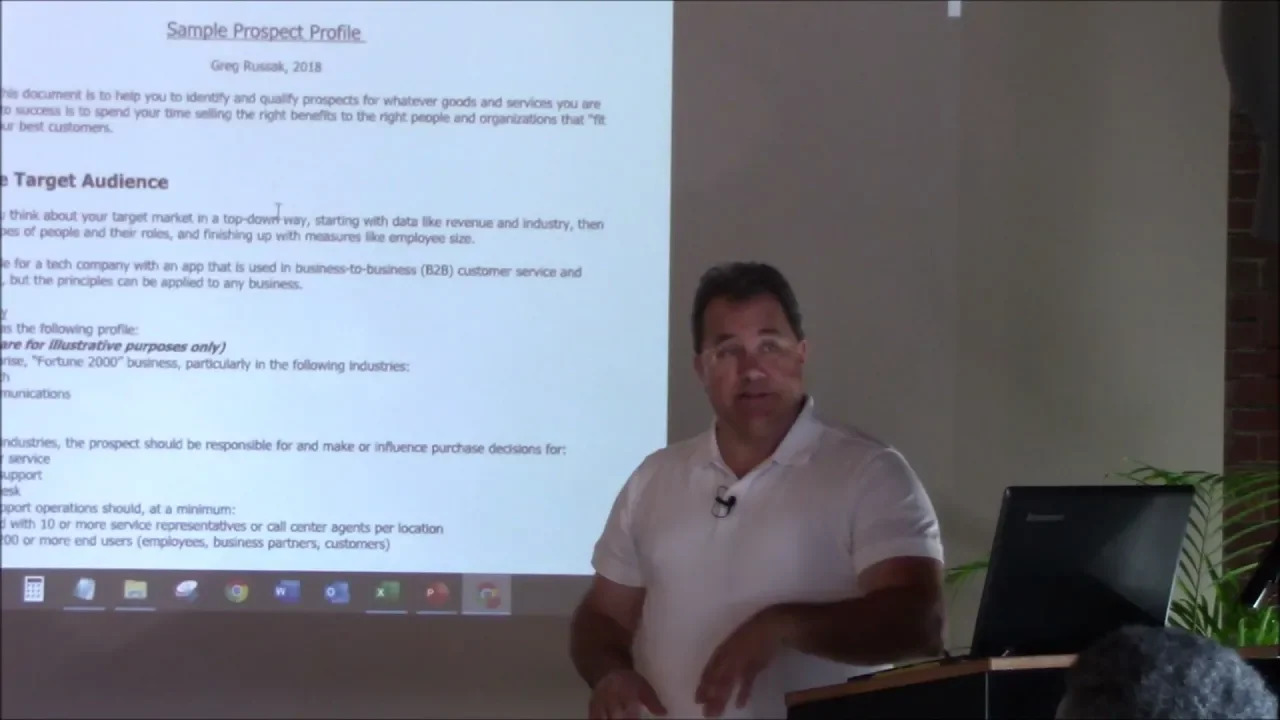
By knowing what makes for a good prospect, you can be confident that you're spending your precious time and energy with the people most likely to become customers.
Here's the 4-step process I use for developing prospect profiles.
(Send me a message from your business email asking for the template, and I'll send it to you.)
Step 1. The Target Audience (Market Segments)
This and Step 2 are tied to product-market fit. This is where you think about your target market in a top-down way, starting with general indicators such as revenue, industry, employee size, etc.
Step 2. General Characteristics of Good, Better, Best Prospects
These are details that paint a clearer picture. It includes things like how your best prospects operate, the markets they serve, how they serve them, and anything that's going to provide clarity for you and the sales teams.
Step 3. Identifying Buyer Types
A prospect is ultimately a person. In B2B, it's often a group of people.
As such, it's important to uncover and account for their personal and professional goals and interests, as well as for their appetite for risk relative to your solution. It's important to think through and develop authentic questions to ask your prospects how they separate themselves as people into buyer types such as Innovators, Early Adopters, Early Majority, Late Majority, and Laggards.
Step 4. Mapping Your Benefits to the Prospect Buyer Types
Time to get specific by mapping all of your benefits to the type of buyer who will see the greatest value in each benefit.
For example, Innovators are people who like to be the first to try something new.
What is it about your solution that will appeal to the people who like being first and who are glad to take calculated risks if there's the potential for reasonable ROI and an edge they'll have over their competitors?
That's what you want to spend your time talking about with Innovators.
Buyers who, on the other hand, are concerned with whether or not your solution is already in use and by how many others; who are legally and/or strategically compelled to follow well-established standards and/or regulations; who look for safety, security, and stability from businesses with whom they partner are all exhibiting characteristics of an Early Majority buyer.
The 3 Big Questions for Sales are:
- Whom do I talk with?
- What do I say?
- Why should they care?
By using Prospect Profiles, you'll be answering Question 1, and your prospecting, qualifying, discovery, and selling will be more efficient.
Your prospects will be far more likely to see you as the Trusted Adviser you are, too, because you're adapting to them instead of pursuing a one-size-fits-all approach.
Want to discuss this further?
Book a free discovery call and let's talk through what's relevant to your business.
Book a Discovery Call