
More like Lincoln and Socrates than Patton or Caesar
May 17, 2024
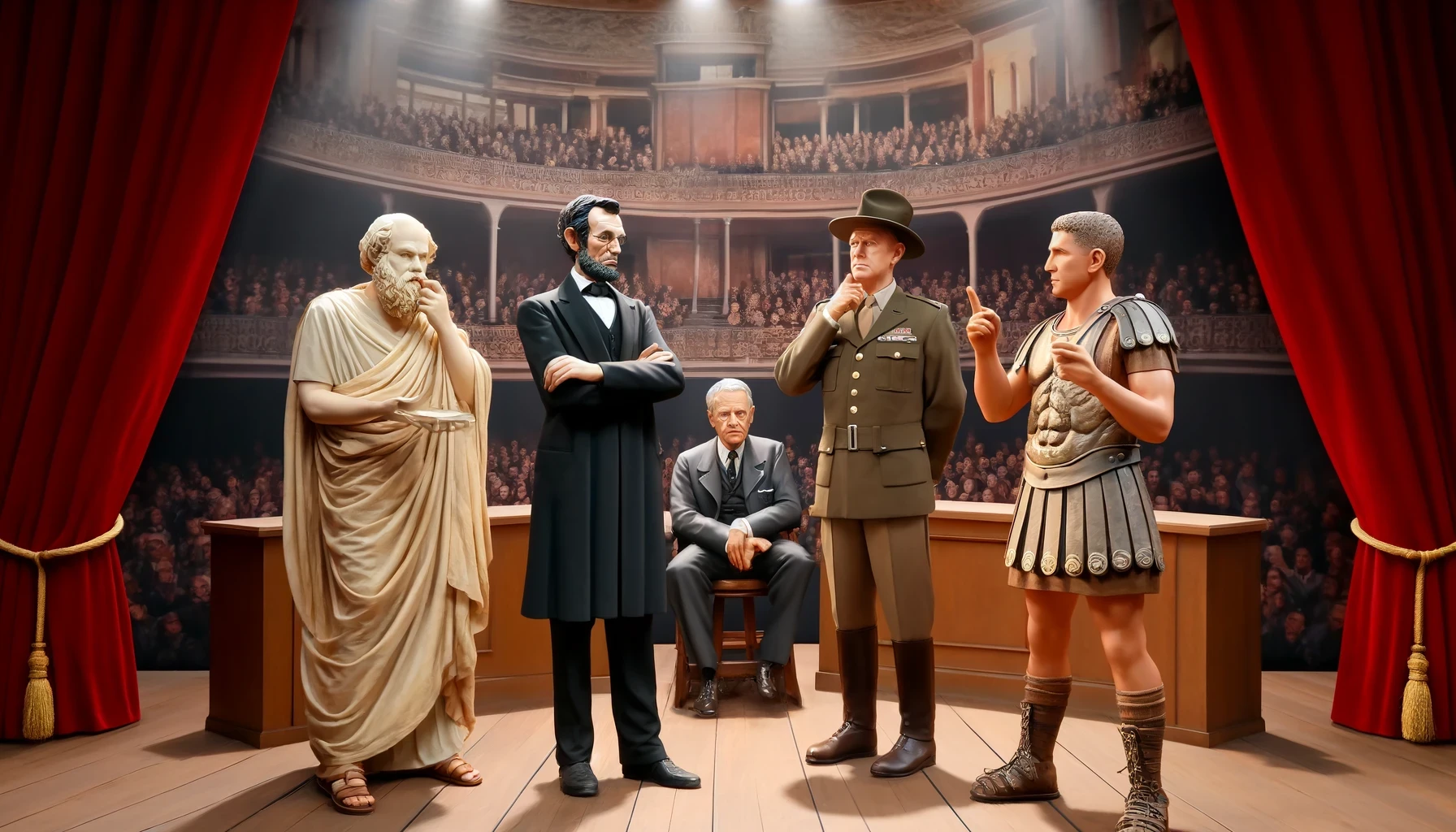
"Self-effacing, quiet, reserved, even shy — these leaders [of great companies] are a paradoxical blend of personal humility and professional will. They are more like Lincoln and Socrates than Patton or Caesar" (Good to Great; Collins, p12-13).
Not what most Americans picture when leadership is talked about, right? We're conditioned to a large extent to value charisma and seemingly inherent traits that leaders seem to be born with.
"Great Man" or Good to Great?
It's interesting to contrast what Thomas Carlyle says in the Great Man theory with the findings of Jim Collins and his team. Collins, a former Stanford University Graduate School of Business faculty member and celebrated researcher and consultant, along with his research associates, published Good to Great in 2001. (Good advice rarely goes out of style.)
In it, Collins and team explain their discovery that the truly great companies were led by a much different sort than expected by the Great Man theory; those that, "... are more like Lincoln and Socrates than Patton or Caesar."
Charisma as Tyranny
Some leadership theories concentrate on charisma — "an extraordinary ability to inspire others and bring forth loyalty" (Manning & Curtis, 2003, p23).
In their book, The Art of Leadership, Manning and Curtis quote the German sociologist, Max Weber, as describing charisma as "a gift or power of leadership" (Manning & Curtis, 2003, p23).
The late James MacGregor Burns, credited with developing the theory of Transformational Leadership, disputed the value of charisma.
Burns was "a presidential biographer, authority on leadership studies, Woodrow Wilson Professor (emeritus) of Political Science at Williams College, and scholar at the James MacGregor Burns Academy of Leadership at the University of Maryland, College Park." He "has been heralded as a pioneer in the study of leadership" (Murphy, 2004). In his studies of Franklin D. Roosevelt, Burns developed the theory of Transformational Leadership "to describe what he saw as FDR's evolution from a transactional leader to one who affected transformation in the people he was leading" (Murphy, 2004).
Burns wrote in his 2003 book, Transforming Leadership:
"At best, charisma is a confusing, undemocratic form of leadership. At worst, it is a type of tyranny" (p27).
Conclusion
Collins and Burns are telling us the same thing: effective, successful leaders put others first. They are not "great men" relying on charisma.
Instead, real leaders lead by connecting with and guiding people. Even in the rapid and ceaseless changes that occur in business today, "the qualities [of successful leadership in the new economy] are worthless if a person in a leadership role does not do the right things right and inspire trust among his or her team, if the strategy for the enterprise is ill-conceived, if there is a weak management team, or if employees are apathetic" (Neff & Citrin, 1999, pxviii).
How does this help you?
Put simply, your decision about how you will lead will absolutely determine who is attracted to you and your company, including investors, employees, partners, and customers.
As Collins describes it in Good to Great, "If we get the right people on the bus, the right people in the right seats, and the wrong people off the bus, then we'll figure out how to take it someplace great" (2001, p41).
Future posts will cover Collins' Hedgehog Concept for determining what you're best at and Braksick's CYBER Model for influencing behavior. Be sure to subscribe so you don't miss them.
Want to discuss this further?
Book a free discovery call and let's talk through what's relevant to your business.
Book a Discovery Call