
Top 10 Reasons to Have Sales Playbooks
November 17, 2024
"Hero sales." You founders know what those are.
For the rest of you, they're those first few really meaningful deals founders win — and that investors look for — as early validation of your product-market fit.
Also known as "evangelical sales," you founders most likely won these deals by "taking the word to the unwashed masses" — suspects and prospects — and "converting them" into customers. You did it through sheer grit, deep product knowledge, and the boundless belief you have in yourself and your solution.
Hero sales, however, don't scale and aren't the path to predictable and sustainable growth.
Sales playbooks will change that.
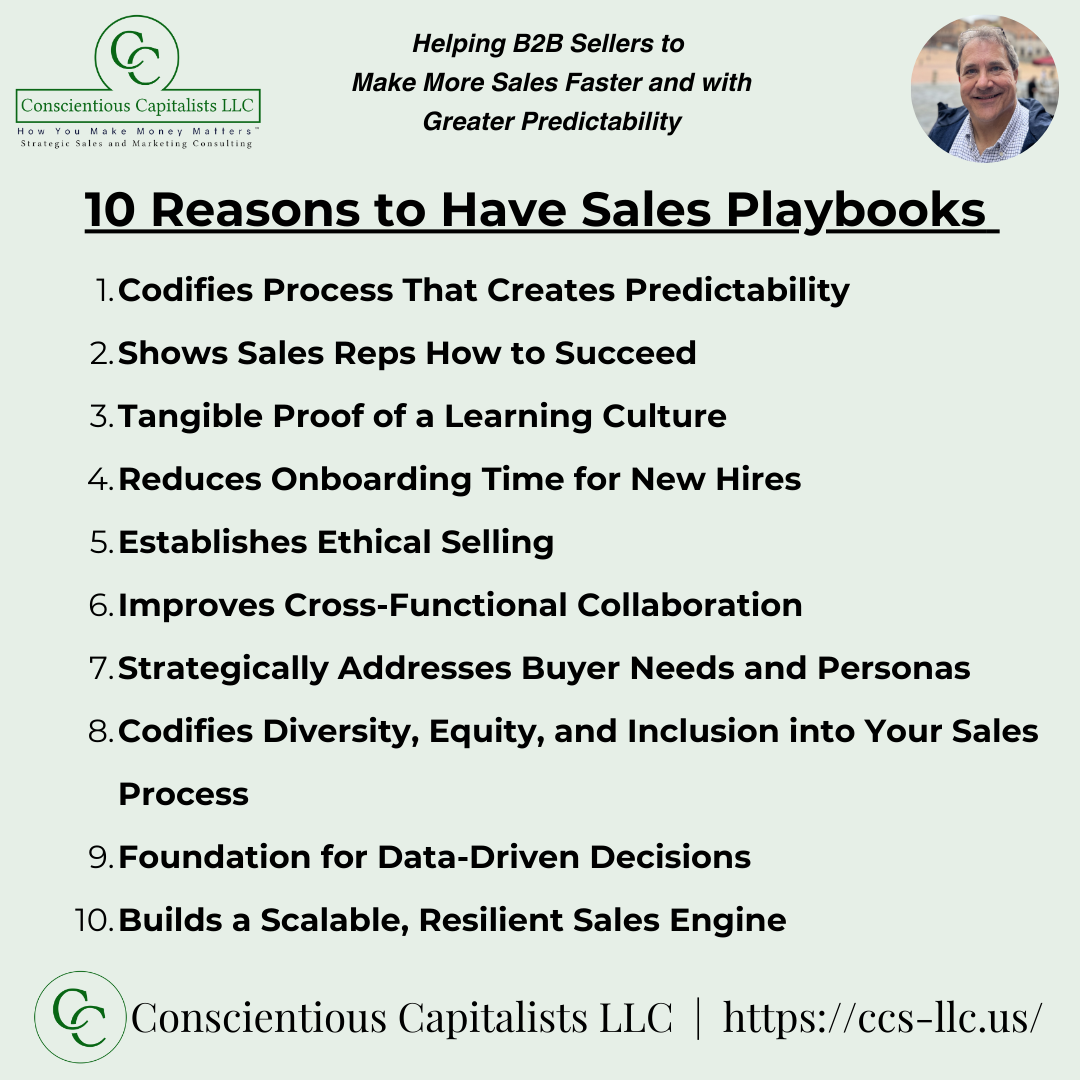
Here are my top 10 reasons to have sales playbooks no matter what stage of growth you're in.
1. Codifies Process That Creates Predictability
Hero sales often hinge on unique skill sets and relationships. While inspiring, they're impossible to replicate across a growing team. A playbook codifies your sales processes, best practices, and proven approaches, ensuring every salesperson follows a consistent methodology. This consistency breeds predictability, making it easier to forecast revenue and hit targets.
Actionable Step: Document the key stages of your successful sales processes. Break down the critical actions taken, questions asked, prospect decision making criteria, and resources used to move deals forward.
2. Shows Sales Reps How to Succeed
A strong sales playbook is just that — a playbook. It tells your sales team what plays to run under different circumstances. It equips them with proven messaging, objection-handling techniques, and strategies that get tested and refined over time. This enables sales reps to sell confidently, even if they lack your deep subject matter expertise.
Actionable Step: Include call scripts, email templates, and competitive positioning guides tailored to each stage of the buyer's journey.
3. Tangible Proof of a Learning Culture
Playbooks aren't static documents, they're living, breathing resources that evolve with market dynamics and customer needs. By encouraging your team to provide feedback and refine the playbook regularly, you cultivate a learning culture that drives innovation and growth.
Actionable Step: Set up quarterly review sessions with your team to assess what's working, what's not, and how the playbook can be improved.
4. Reduces Onboarding Time for New Hires
As you scale, new hires need to ramp up quickly. A comprehensive sales playbook dramatically shortens this learning curve by giving them access to a wealth of battle-tested strategies and resources from day one. This ensures they become productive faster and helps prevent costly missteps.
Actionable Step: Include role-play scenarios and "shadowing" exercises in your playbook and onboarding plan to help new hires see the playbook in action.
5. Establishes Ethical Selling
What is and is not ethical behavior must be codified in your playbook. Instead of relying on instinct or the individual rep to decide what's ethical, your sales team needs to know how you define it. They then can follow clear guidelines on setting customer expectations and building trust.
Actionable Step: Be explicit. Integrate your company's core values and ethical standards into your playbook to be very clear about how deals are closed and customer interactions are handled.
6. Improves Cross-Functional Collaboration
Sales doesn't exist in a vacuum. Effective playbooks align sales activities with marketing, product development, and customer success, creating a unified approach to customer acquisition and retention. Everyone understands their role and how they contribute to the customer experience.
Actionable Step: Include marketing assets, customer feedback loops, and internal communication protocols in your playbook.
7. Strategically Addresses Buyer Needs and Personas
Every buyer is unique, but patterns emerge when you analyze the deals you've closed. A playbook helps you define target personas, pain points, and value propositions, ensuring your team speaks directly to buyer needs rather than taking a one-size-fits-all approach.
Actionable Step: Include how you map what customers value about your solution by buyer type. Your sales team will do a better job earning trust and moving the deal forward by knowing "which language to speak" for different buyer types and challenges.
8. Codifies Diversity, Equity, and Inclusion (DEI) into Your Sales Process
A thoughtfully built playbook goes beyond typical sales tactics. It embodies your commitment as a leader to building a diverse and inclusive workplace when you write into your playbook explicit DEI-oriented instructions for handling customer interactions, team management and communication, and what candidates for sales jobs need to understand about you and who you are as a leader.
Actionable Step: Include instruction and direction on inclusive communication, unconscious bias training resources, and how to connect authentically with diverse customer audiences.
9. Foundation for Data-Driven Decisions
Playbooks lay the foundation for tracking and measuring the effectiveness of sales strategies, processes, and people. You end up knowing what data you need and why you need it to guide your decisions. From what mix of prospecting activities work best for different types of buyers, to how many touches does it really take to get them engaged, to what's the average deal velocity and where can we speed it up — everything that happens in sales — you will have the means for continuously optimizing your sales process.
Actionable Step: First time writing a sales playbook? Start with a manageable number of key performance indicators (KPIs). You can always add more. Encourage others (if they need it!) in your company — including your reps — to bring their questions about sales to you. This ought to be answered by you, your team, and how you do things — your sales playbook.
10. Builds a Scalable, Resilient Sales Engine
Ultimately, a playbook turns selling into a repeatable, scalable process that doesn't depend on heroics. When everyone knows how to execute, adapt, and improve, you've built a resilient sales engine capable of withstanding market shifts and growing with your business.
Actionable Step: Get started today. If you need help, I'm here.
Leading with Integrity and Culture-Driven Strategy
Creating and maintaining a sales playbook is absolutely about driving sales. It's also one of your company's most important and informative cultural artifacts.
What goes into it will be one of the most meaningful and public ways you and your sales reps will tell your story and begin earning trust from prospects, partners, and customers.
By codifying your values and approach to selling, setting standards for ethical behavior, and fostering a learning-oriented environment, you'll empower your sales team to sharpen their skills and to sell with confidence and integrity.
Your sales playbook is the key to sustainable, predictable growth, and to making sure your vision becomes a shared mission, executed with passion and purpose.
Want to discuss this further?
Book a free discovery call and let's talk through what's relevant to your business.
Book a Discovery Call